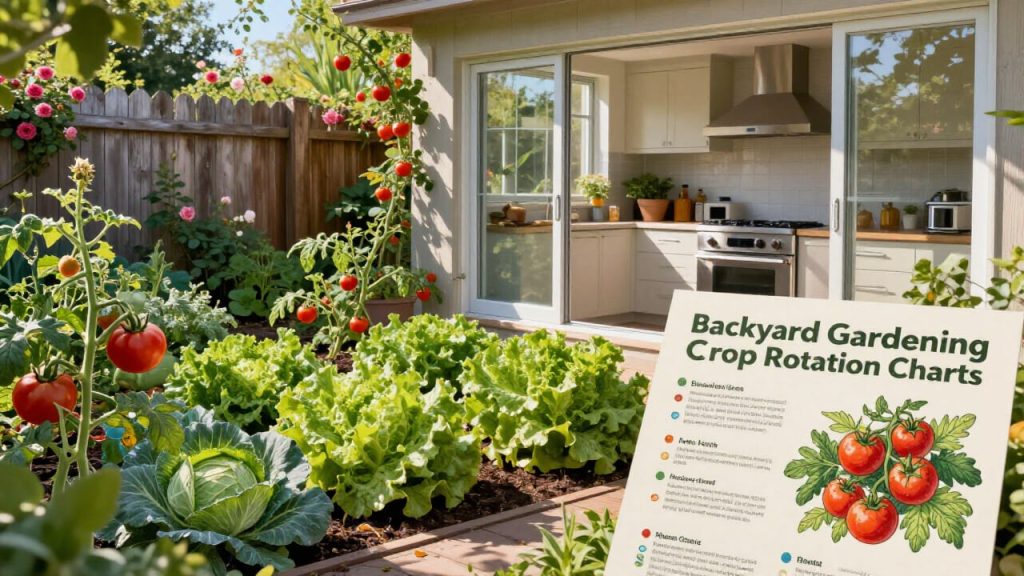
Backyard Gardening Crop Rotation Charts
Think of crop rotation as giving your soil a balanced diet rather than forcing it to digest the same meal repeatedly. Different plant families have unique nutrient needs and contribute distinct benefits back to the soil. With thoughtful backyard gardening crop rotation charts, you’ll create a self-sustaining cycle that improves your garden’s health year after year.
Key Takeaways: Backyard Gardening Crop Rotation Charts
- Crop rotation enhances soil fertility and naturally reduces pests, even in small backyard gardens
- Organizing plants into four major family groups simplifies the rotation process for beginners
- A simple 4-year rotation plan can be adapted to any garden size, including raised beds and containers
- Rotating crops can increase yields by up to 30% compared to planting in the same location year after year
- Garden Success provides easy-to-follow rotation charts that help eliminate the confusion of where to plant each season
Crop rotation isn’t just for large farms—it’s the secret weapon that can transform your small backyard garden into a thriving ecosystem. If you’ve ever struggled with declining yields or persistent pest problems, implementing a simple rotation system might be exactly what your garden needs. Even with just a few raised beds or a modest in-ground plot, rotating plant families can make a dramatic difference in your gardening success.
When I first started my small backyard garden, I planted tomatoes in the same spot year after year, wondering why they became increasingly disease-prone and less productive. It wasn’t until I learned about backyard gardening crop rotation charts that my garden truly began to flourish. Garden Success offers excellent resources that show how rotating crops can prevent pest buildup while naturally balancing soil nutrients—without requiring any chemicals or fancy equipment.
Why Your Garden Needs Crop Rotation (Even If It’s Tiny)
The misconception that crop rotation only matters for large-scale farming keeps many backyard gardeners from reaping its substantial benefits. Even a single 4×8 raised bed can benefit dramatically from a well-planned rotation system. The principle is simple: different plant families interact with soil differently—some deplete certain nutrients while others replenish them.
When you grow the same crops in the same location year after year, you create the perfect conditions for specialized pests and diseases to thrive. Tomato hornworms that overwinter in the soil will emerge to find a feast waiting if you’ve planted tomatoes in the same spot again. Similarly, soil-borne diseases like blight have a much easier time infecting plants when their preferred hosts return to the same location repeatedly.
Beyond pest management, crop rotation directly impacts your soil’s fertility profile. Nightshades like tomatoes are heavy nitrogen feeders, while legumes actually add nitrogen back to the soil. By following nitrogen-hungry crops with nitrogen-fixing legumes, you create a natural fertility cycle. For more detailed guidance on this practice, check out this crop rotation guide. This means less fertilizer, fewer pests, healthier plants, and significantly better harvests—often with yields increasing by 20-30% compared to static planting.
The Four Plant Families Every Gardener Should Know
The foundation of drawing up effective backyard gardening crop rotation charts, lie in understanding plant families. While botanists classify plants into dozens of families, for practical gardening purposes, we can simplify into four main groups that share similar characteristics, nutrient needs, and susceptibility to pests and diseases.
Nightshades (Solanaceae): Tomatoes, Peppers, Eggplants
The nightshade family includes some of the most beloved garden crops: tomatoes, peppers, eggplants, and potatoes. These plants are typically heavy feeders that demand rich, well-balanced soil with plenty of nitrogen. They’re also susceptible to similar diseases like early and late blight, which can persist in soil for years. Nightshades generally benefit from following legumes in your rotation plan, taking advantage of the nitrogen left behind.
Brassicas (Crucifers): Broccoli, Cabbage, Kale
Brassicas comprise the cabbage family—broccoli, cauliflower, kale, Brussels sprouts, and radishes among others. These crops prefer cooler weather and are moderate to heavy feeders with high calcium requirements. They’re particularly vulnerable to club root disease and various insect pests like cabbage worms and root maggots. Brassicas perform well following nightshades in rotation, as they utilize different soil nutrients and help break pest cycles.
Legumes: Beans, Peas, Peanuts
Legumes are the soil improvers of the garden world. Through a symbiotic relationship with rhizobium bacteria in their root nodules, beans, peas, and other legumes can fix atmospheric nitrogen and convert it to a form plants can use. This makes them ideal to plant after heavy-feeding crops like brassicas. In addition to their soil-building properties, legumes generally have fewer pest and disease problems than other crop families, giving your garden a recovery period in the rotation cycle.
Root Vegetables and Leafy Greens
The final group in our rotation system combines root crops like carrots, beets, and onions with leafy greens such as lettuce, spinach, and chard. While taxonomically diverse, these plants generally have similar cultural requirements and pest susceptibilities. Most are light to moderate feeders that prefer well-drained soil rich in organic matter. This group works well following legumes in rotation, taking advantage of the balanced soil nutrients without requiring excessive fertility.
Simple 4-Year Rotation Plan for Small Gardens
Implementing a rotation system doesn’t have to be complicated. The most practical approach for home gardeners is a 4-year rotation that cycles through the major plant families. By dividing your garden into four distinct sections or beds, you can systematically move each plant family to a new location each year, completing the full cycle in four years.
Year 1: Initial Planting Layout
Begin by dividing your garden space into four roughly equal sections. In the first section, plant your legumes (beans and peas). The second section will house nightshades (tomatoes, peppers, eggplants). Your third section is for brassicas (cabbage, broccoli, kale), while the fourth accommodates root vegetables and leafy greens. This initial arrangement establishes the foundation for your rotation system.
Year 2: First Rotation Shift
In the second year, each plant family moves one position clockwise or counterclockwise (your choice, just be consistent). Legumes shift to where nightshades were, nightshades move to the brassica section, brassicas relocate to the root vegetables area, and root crops take over the former legume bed. This systematic movement ensures that no plant family returns to the same soil for four years, breaking pest and disease cycles.
Year 3: Second Rotation Shift
Continue the rotation pattern in year three, with each plant family moving one more position in the same direction. Legumes now occupy the former brassica bed, nightshades take over where root vegetables grew, brassicas move to the previous legume section, and root vegetables fill the nightshade plot. This continued movement maximizes nutrient efficiency and maintains soil health through diverse root structures.
Year 4: Completing the Cycle
In the fourth year, complete the rotation cycle with one final shift. By the end of year four, each plant family will have grown in all four sections of your garden, creating a balanced system. When you begin year five, you’ll return to the original layout from year one, but with improved soil health and reduced pest pressure due to the four-year break between related crops occupying the same space.
Benefits You’ll See From Proper Crop Rotation
The advantages of implementing even a simple rotation system extend far beyond theoretical soil science. You’ll notice tangible improvements in your garden’s performance within the first complete rotation cycle.
Fewer Pests Without Chemicals
By moving crops to new locations each year, you disrupt the life cycles of specialized pests and pathogens. Colorado potato beetles, for instance, emerge from the soil in spring looking for solanaceous hosts. If you’ve moved your potatoes and tomatoes to a different bed, these pests must migrate further to find food, exposing themselves to predators and reducing their population. This natural control method can reduce pest pressure by up to 80% without applying a single pesticide, creating a healthier ecosystem in your garden. For more information, check out this crop rotation guide for vegetable gardens.
Better Soil Health and Nutrient Balance
Different crops interact with soil in unique ways through their distinctive root structures, nutrient requirements, and microbial associations. Deep-rooted plants like tomatoes draw nutrients from lower soil layers, while shallow-rooted crops utilize the upper profile. When rotated properly, this creates complementary patterns of soil utilization.
Legumes form the cornerstone of soil improvement in rotation systems. Through their nitrogen-fixing capabilities, beans and peas can add 30-50 pounds of nitrogen per acre, significantly reducing the need for added fertilizers. This natural fertility cycling creates more resilient soil that retains nutrients efficiently.
Beyond macronutrients, backyard gardening crop rotation charts assisting in managing soil pH and micronutrient availability. Brassicas, for example, are efficient at extracting calcium from soil, while root crops excel at accessing phosphorus. By rotating these families, you create more balanced nutrient cycling.
The diverse root structures associated with different plant families also improve soil structure and drainage. Deeply taproot plants like carrots create channels for water infiltration, while the fibrous roots of grasses and certain greens bind soil particles together, reducing erosion and compaction.
- Improved water retention and drainage
- Increased soil organic matter
- Enhanced microbial diversity
- Reduced fertilizer requirements
- Better aeration and root penetration
Increased Harvests (With Examples)
The ultimate proof of crop rotation’s effectiveness appears in your harvest baskets. Research consistently shows yield increases of 10-30% when proper rotation is practiced compared to continuous cropping. In my own garden, tomato yields increased by nearly 25% after implementing a four-year rotation plan, with significantly fewer signs of disease and better fruit quality. Similarly, brassicas grown following legumes showed improved head formation and fewer pest problems than those planted after other brassicas, demonstrating how the right rotation sequence directly impacts crop performance.
Common Crop Rotation Mistakes to Avoid
While crop rotation offers tremendous benefits, certain common mistakes can undermine your efforts. Awareness of these pitfalls will help you design a more effective system tailored to your specific garden conditions and goals.
Forgetting Which Plants Grew Where
The most frequent rotation error occurs when gardeners simply can’t remember their previous planting locations. Without accurate records, you might inadvertently plant the same family in the same location, negating the benefits of rotation. Create a simple garden map each season and keep it in a dedicated garden journal or digital app. Take photos of your garden layout at planting time as visual documentation.
For those who prefer a more systematic approach, consider installing permanent bed markers with rotation numbers or colors that correspond to your plan. This visual reminder makes it easy to track which bed should receive which plant family in the current season, eliminating guesswork and ensuring consistent implementation.
Ignoring Plant Family Relationships
Another common mistake is failing to recognize plant family connections when planning rotations. For example, potatoes and tomatoes belong to the same family (Solanaceae) and are susceptible to similar diseases like late blight. Planting potatoes where tomatoes grew the previous year doesn’t constitute proper rotation since they share pest vulnerabilities. Always group plants by botanical family rather than by garden use or appearance to ensure effective pest and disease management through your rotation system.
Backyard Gardening Crop Rotation Charts You Can Use Today
Implementing crop rotation becomes significantly easier with visual tools that map out the movement of plant families through your garden beds. These practical charts eliminate confusion and provide a clear roadmap for seasonal planting decisions, helping you maintain consistency in your rotation system.
- Color-coded family groupings for visual clarity
- Sequential arrows showing movement patterns
- Planting calendars integrated with rotation positions
- Companion planting suggestions for each rotation block
- Soil amendment recommendations based on previous crops
Basic 4-Bed Rotation Chart
This fundamental rotation chart provides an easy-to-follow system for managing a typical backyard garden. By dividing your growing space into four equal sections, you can implement a complete rotation cycle that maximizes soil health while minimizing pest pressure.
| Bed Location | Year 1 | Year 2 | Year 3 | Year 4 |
|---|---|---|---|---|
| Bed 1 | Legumes | Nightshades | Brassicas | Root Vegetables |
| Bed 2 | Nightshades | Brassicas | Root Vegetables | Legumes |
| Bed 3 | Brassicas | Root Vegetables | Legumes | Nightshades |
| Bed 4 | Root Vegetables | Legumes | Nightshades | Brassicas |
Following this rotation sequence ensures that heavy feeders like tomatoes benefit from the nitrogen fixed by previous legume plantings, while susceptible crops like brassicas get a three-year break from potential disease buildup in any particular bed. The systematic movement creates a sustainable nutrient cycle that works with natural processes rather than against them.
Small Space 2-Bed Rotation Chart
For gardeners with limited space, this simplified two-bed rotation system still provides many benefits while accommodating space constraints. While not as comprehensive as a four-bed system, it significantly improves upon continuous cropping in the same location.
Two-Bed Rotation Strategy: Divide plants into two main groups—soil builders (legumes, some greens) and soil users (nightshades, brassicas, root crops). Alternate these groups between your two beds each year, ensuring that soil-depleting crops always follow soil-building ones.
This approach might not provide the full four-year break from plant-specific pathogens, but it still interrupts pest cycles and helps maintain soil fertility through alternating heavy feeders with soil improvers. For tiny urban gardens or balcony setups, even this simplified rotation offers substantial benefits compared to static planting patterns.
Advanced 6-Bed Rotation System
Experienced gardeners with more space might consider this expanded six-bed rotation system that creates even longer intervals between related crops returning to the same soil. This approach further subdivides plant families and incorporates dedicated cover crop beds for maximum soil regeneration.
The six-bed system separates the root vegetable/leafy green category into two distinct rotation positions and adds a dedicated cover crop section that focuses exclusively on soil building for one season. This intensive approach particularly benefits gardens with heavy soil disease pressure or those practicing strict organic methods where soil health is paramount.
How to Adapt Rotation Plans for Your Garden Size
One of the most common concerns I hear from gardeners is that their space is too small or irregularly shaped to implement proper crop rotation. Fortunately, the principles can be adapted to virtually any garden configuration with a bit of creativity and planning.
Container Garden Rotations
Even container gardens benefit from rotation principles, though the approach differs slightly from in-ground systems. Instead of moving plants to different locations, you’re effectively rotating the soil itself by replacing or refreshing potting media between plantings. After growing a heavy feeder like tomatoes in a container, refresh the soil with compost and plant a nitrogen-fixer like beans before returning to another heavy feeder in the third season. Alternatively, physically move containers to different positions on your patio or balcony to disrupt potential pest cycles while maintaining the appropriate light requirements for each plant type.
Raised Bed Solutions
Raised beds offer an ideal environment for implementing organized rotation plans, as their clearly defined boundaries make it easy to track which family grew where. For gardens with just two raised beds, consider dividing each bed into two sections, creating four rotation zones that allow a complete four-year cycle. You might plant nightshades and root vegetables in separate halves of one bed, with legumes and brassicas occupying the other bed, then rotate these sections according to your plan. This approach maximizes space while maintaining the integrity of your rotation system.
In-Ground Garden Systems
Traditional in-ground gardens often present the greatest challenge for organized rotation due to their sometimes amorphous boundaries and varying soil conditions. Establish permanent pathways to divide your garden into distinct planting areas that can be easily tracked from year to year. Consider using physical markers like colored stakes to designate which rotation group belongs in each section for the current season. For irregular garden shapes, focus on maintaining approximately equal square footage for each plant family rather than perfectly symmetrical beds.
Special Considerations for Perennial Vegetables
Perennial vegetables like asparagus, rhubarb, and artichokes present a unique challenge in rotation planning since they remain in the same location for years or even decades. The key is to establish these plants outside your main rotation system in dedicated permanent beds. When incorporating perennials into your garden design, position them where they won’t interfere with the rotation of annual vegetables. Consider using perennials as garden borders or in corner locations that create natural boundaries for your rotating annual beds. This separation prevents perennials from disrupting your rotation sequence while still allowing you to benefit from their long-term productivity.
Make Your Own Customized Rotation Plan
While standard rotation templates provide excellent starting points, creating a customized plan tailored to your specific growing conditions and food preferences often yields the best results. Consider factors like your regional climate, existing soil conditions, and which vegetables your family actually enjoys eating. A rotation plan that emphasizes your favorite crops while accommodating your garden’s unique characteristics will be easier to maintain consistently over multiple growing seasons.
Free Templates and Printables
Numerous free resources exist to help you design and track your rotation system without starting from scratch. County extension offices often provide regionally-appropriate rotation templates that consider local pest pressures and growing seasons. Garden Success offers downloadable planning grids that can be customized to your specific bed configurations and preferred crops. These tools typically include color-coded family groupings and clear movement patterns that simplify the planning process, making rotation accessible even for beginners. Look for printables that include companion planting suggestions alongside rotation guidelines for an integrated approach to garden planning.
Digital Apps for Garden Planning
For tech-savvy gardeners, digital planning tools offer sophisticated features that automatically track rotation histories and suggest optimal planting locations. Apps like Garden Plan Pro and Veggie Garden Planner include built-in rotation tracking that alerts you when you attempt to plant a crop family in the same location too frequently. Most of these applications maintain your garden history across multiple seasons, eliminating the need to manually record previous plantings.
Digital Planning Advantages: Automatic crop family identification, visual rotation tracking across seasons, customizable bed layouts, companion planting suggestions, and integrated planting calendars make digital tools particularly valuable for complex garden systems.
These platforms often include extensive plant databases that automatically categorize vegetables by family, removing the guesswork from rotation planning. Many also offer cloud backup, ensuring you never lose your garden history due to misplaced paper records or computer failures.
The small investment in a quality garden planning app often pays dividends through improved organization and more effective rotation implementation, particularly for gardeners managing multiple beds or complex planting schedules.
Creating a Garden Journal for Tracking
- Dedicate a section specifically to rotation tracking with annual garden maps
- Include planting dates, varieties used, and observations about performance
- Document pest and disease issues to identify potential rotation breakdowns
- Photograph each bed at planting time for visual reference
- Note soil amendments applied to each section for future reference
A well-maintained garden journal becomes an invaluable resource over time, revealing patterns and correlations between rotation practices and garden outcomes. For more detailed guidance, consider exploring this crop rotation guide for vegetable gardens. Consider using a weather-resistant notebook that can accompany you into the garden, where observations can be recorded immediately rather than relying on memory later.
Many gardeners find that combining analog and digital methods provides the most robust tracking system. A physical journal captures in-the-moment observations and sketches, while digital tools manage the longer-term rotation planning and history.
The key to successful journal tracking is consistency—establish a routine for updating your records throughout the growing season rather than attempting to reconstruct the information from memory at season’s end.
Start Your Rotation System This Growing Season
The best time to implement and draw up backyard gardening crop rotation charts is right now, regardless of your garden’s current state. Even if you’ve been planting without rotation for years, you can begin the process with your next planting cycle. Start by mapping your existing garden and identifying which plant families are currently growing where. Use this as your baseline for planning the next season’s rotation, gradually transitioning to a complete system over several growing cycles. For more detailed guidance, check out this crop rotation guide. Remember that an imperfect rotation system still provides significant benefits compared to no rotation at all.
As you implement your rotation plan, remain flexible and willing to adapt. Unexpected circumstances like crop failures or weather events may occasionally force modifications to your ideal rotation sequence. The goal isn’t perfect adherence to a rigid system but rather consistent improvement in your garden’s overall health through thoughtful crop placement over time. With each completed rotation cycle, you’ll develop a deeper understanding of how different plant families interact with your specific soil conditions, allowing for increasingly refined and effective rotation strategies in future seasons. For more insights, consider referring to this crop rotation guide.
Frequently Asked Questions About Backyard Gardening Crop Rotation Charts
Throughout my years of teaching gardening workshops, certain questions about backyard gardening crop rotation charts consistently arise. These common concerns often prevent gardeners from implementing rotation systems that could dramatically improve their results. Understanding these practical considerations can help you overcome hesitations about starting your own rotation plan.
The following questions address the most common rotation challenges facing home gardeners, with practical solutions that can be implemented in gardens of any size. While commercial farmers might need more complex approaches, these simplified strategies provide the core benefits of rotation while remaining accessible for backyard implementation.
- How strict do rotation plans need to be to see benefits?
- Can rotation help with specific pest problems I’m experiencing?
- What if certain vegetables perform better in specific locations in my garden?
- How do I incorporate new vegetables into an established rotation?
- Is crop rotation compatible with companion planting strategies?
Even implementing a partial rotation system will yield noticeable improvements compared to continuous cropping. Start with whatever level of organization feels manageable, then refine your approach as you gain experience and observe the positive impacts on your garden’s health and productivity.
Remember that the ultimate goal of rotation is creating a more resilient and productive garden ecosystem. The specific details of implementation matter less than the consistent application of the core principle: avoid planting the same family in the same soil year after year.
Can I rotate crops in a container garden?
Absolutely! Container gardening benefits tremendously from rotation principles, though the application differs slightly from in-ground systems. Since containers have limited soil volume, nutrient depletion and pathogen buildup can occur even more rapidly than in open gardens. The simplest approach is to completely replace potting mix between plantings of the same family, but this can become expensive and wasteful. A more sustainable method is to practice “soil rotation” by refreshing container media with compost between plantings and following heavy feeders like tomatoes with soil-building crops like beans. Alternatively, physically rotate the containers themselves to different positions while maintaining the same four-family sequence used in traditional rotation systems.
What if I don’t have space for four separate beds?
Limited space doesn’t prevent you from implementing effective rotation strategies. For small gardens with just one or two beds, consider dividing each bed into sections that represent different rotation blocks. A single 4’×8′ raised bed can be divided into four 2’×4′ sections, each hosting a different plant family. In subsequent years, shift families within this single bed following the same pattern you would use across multiple beds. Another approach is to simplify to a two-part rotation, alternating between soil-building crops (legumes) and soil-depleting crops (everything else) if space is extremely limited. While not as comprehensive as a four-family rotation, this simplified approach still provides significant benefits compared to continuous cropping.
How do I know which family my vegetable belongs to?
Identifying plant families is essential for effective rotation, yet many gardeners find this aspect intimidating. Rather than memorizing botanical classifications, create a simple reference chart categorizing common vegetables into the four main rotation groups. Nightshades include tomatoes, peppers, eggplants, and potatoes. Brassicas encompass broccoli, cabbage, cauliflower, kale, radishes, and turnips. Legumes comprise all beans, peas, and peanuts. The root/leafy group includes carrots, beets, onions, lettuce, spinach, and chard. For more detailed guidance, check out this crop rotation guide for vegetable gardens.
For less common vegetables, a quick internet search for “[vegetable name] plant family” will typically reveal its classification. Many seed catalogs and garden planning apps also categorize vegetables by family, eliminating guesswork. When in doubt about a particular crop, err on the side of caution and avoid planting it where any potentially related crops grew the previous season.
Consider creating a color-coded plant family chart to keep in your garden journal or tool shed as a quick reference. This visual aid simplifies planning and helps maintain consistency in your rotation system, particularly when introducing new vegetables to your garden.
What should I do if I forgot what I planted where last year?
Losing track of previous plantings is a common challenge, especially when first implementing rotation systems. If you can’t recall last year’s layout, look for clues in the garden itself. Root remnants, volunteer seedlings, and distinctive growth patterns in the soil often reveal what grew where. When all else fails, implement a “best guess” rotation based on whatever information you can piece together, then commit to better record-keeping moving forward.
To prevent this situation in the future, establish a consistent documentation system. This might include a dedicated garden journal with dated maps, a photo series taken at planting time, or durable garden markers that remain in place throughout the season. Many gardeners find that a combination of physical markers in the garden and digital or written records provides the most reliable tracking system.
Are there any plants that don’t need to be rotated?
While most annual vegetables benefit from rotation, certain plants can be more flexible in placement. Herbs generally have lower nutrient demands and different pest susceptibilities than vegetables, making them less critical to include in strict rotation sequences. Plants grown primarily for their flowers rather than food production, like marigolds or nasturtiums, can often remain in consistent locations, especially when used as border plantings or companion plants.
Sweet corn represents an interesting exception among food crops. Though technically a heavy feeder, corn has different disease susceptibilities than most garden vegetables and forms mycorrhizal relationships that can benefit subsequent crops. Some rotation systems treat corn as its own category, allowing it to precede nearly any other crop family.
That said, even these more flexible plants will likely perform better when included in rotation. The key principle remains: diversity in planting locations generally promotes healthier soil and more resilient crops, regardless of plant type.

As you gain experience with expertly drawing up backyard gardening crop rotation charts, you’ll develop an intuitive sense for which plants seem most affected by continuous cropping in your specific garden conditions. Let these observations guide refinements to your rotation strategy over time, gradually creating a system optimized for your unique growing environment.