Implementing A Utility Bill Reduction Action Plan
Your utility bills don’t have to break the bank each month. With strategic changes and smart habits, most households can implement a Utility Bill Reduction Action Plan in order to reduce their monthly expenses by 20-30% without sacrificing comfort.
Key Takeaways On A Utility Bill Reduction Action Plan
- Reducing utility bills starts with understanding your usage patterns and identifying peak consumption times to save up to 25% on energy costs.
- Simple DIY improvements like sealing air leaks and installing weatherstripping can cut heating and cooling costs by 15-20% with minimal investment.
- Many homeowners qualify for financial assistance programs that can cover up to 100% of energy-efficient upgrades or provide significant bill discounts.
- Smart thermostats and modern appliances can reduce your utility bills by automatically optimizing usage based on your habits and peak rate times.
- Creating a 30-day utility bill reduction action plan with weekly milestones makes reducing utility costs manageable and leads to sustained savings over time.
I’ve helped hundreds of families slash their energy costs, and I’m going to share exactly how you can do the same. The secret lies not in drastic lifestyle changes but in understanding your home money management and making targeted adjustments that deliver the biggest impact.
Proven Strategies to Slash Your Utility Bills Today
Before diving into specific tactics, it’s important to recognize that a utility bill reduction action plan requires a multi-faceted approach. The most successful savers combine immediate changes with long-term improvements. They also understand their usage patterns and take advantage of available assistance programs. This comprehensive strategy ensures you’re attacking the problem from all angles rather than focusing solely on one aspect like thermostat settings or water usage.
Understanding Your Energy Usage Patterns
The first step to reducing any expense is understanding where your money is going. Most utility companies provide detailed breakdowns of your usage, often accessible through online accounts or mobile apps. Take time to review your consumption patterns over the past 12 months, noting seasonal variations and peak usage times. Look for unusual spikes that might indicate inefficiencies or malfunctioning equipment. Many utility providers also offer free energy audits that provide personalized recommendations based on your specific home and usage patterns.
Quick Home Improvements That Pay Off Fast
You don’t need to invest thousands in solar panels to see immediate savings. Start with low-cost, high-impact improvements that can be completed in a weekend. Weather stripping around doors and windows costs just $3-$5 per door but can save 10-15% on heating and cooling costs. LED light bulbs use 75% less energy than incandescent bulbs and last 25 times longer. Installing low-flow shower heads for $15-$20 can reduce your water heating costs by up to 16% while maintaining good water pressure.
Advanced power strips that eliminate phantom energy drain from electronics can save an average household $200 annually. These simple upgrades typically pay for themselves within 1-3 months and continue delivering savings for years.
Financial Assistance Programs You May Qualify For
Many homeowners leave money on the table by not exploring available assistance programs. The federal Weatherization Assistance Program provides free energy efficiency upgrades to qualifying low-income households. Many utility companies offer income-based discount programs that can reduce your bill by 20-35%. Even middle-income households often qualify for rebates when purchasing energy-efficient appliances or making home improvements.
Don’t assume your income is too high to qualify – program thresholds vary widely, and some are designed specifically for middle-income families. A quick call to your utility provider can identify programs you may be eligible for, potentially saving hundreds or even thousands annually.

Decode Your Utility Bills and Find Hidden Savings
Your utility bill contains valuable information that can help you identify savings opportunities. Learning to read and understand these documents is crucial to developing an effective reduction strategy. Most people focus only on the total amount due, missing important clues about their consumption patterns and rate structures.
Common Bill Components Most People Overlook
Beyond the total amount due, pay attention to delivery charges, supply charges, and various fees that make up your bill. Many utilities include a usage history comparison showing how your current consumption compares to previous months and even previous years. This data helps identify unusual patterns that might indicate inefficiencies or equipment problems. Some bills also include efficiency rankings that compare your home to similar homes in your neighborhood – a low ranking suggests significant improvement potential.
Understanding fixed versus variable charges is particularly important. Fixed charges remain the same regardless of your usage, while variable charges fluctuate based on consumption. Focus your conservation efforts on reducing the variable portion, as that’s where your behavior changes will have the most impact.
Peak vs. Off-Peak: Timing Your Energy Use
Many utility companies charge different rates depending on when you use electricity. During high-demand periods (typically weekday afternoons and early evenings), rates can be 30-50% higher than during off-peak hours. Simply shifting energy-intensive activities like laundry, dishwashing, and charging electric vehicles to off-peak hours can significantly reduce your bills without reducing your total consumption.
Example Savings: A family of four that shifts 40% of their electricity usage from peak to off-peak hours could save approximately $25-$40 per month, assuming a rate difference of 10¢/kWh between peak and off-peak periods and average monthly usage of 1,000 kWh.
Spotting Billing Errors That Cost You Money
Billing errors happen more frequently than you might think. Take a few minutes each month to verify your meter readings match what’s reported on your bill. If you’ve recently made efficiency upgrades, ensure your bill reflects the expected reductions. Watch for unexpected fees or rate changes that weren’t properly communicated. If your bill suddenly increases without explanation, contact your utility provider immediately – I’ve helped clients recover hundreds of dollars from simple billing mistakes that would have gone unnoticed.
Many utilities also offer budget billing programs that average your costs throughout the year, making expenses more predictable and helping you avoid seasonal bill spikes. While this doesn’t directly reduce your overall costs, it makes budgeting easier and prevents unpleasant surprises during extreme weather months.
5 Home Efficiency Upgrades That Pay For Themselves
Strategic home improvements offer the best long-term return on investment for utility bill reduction action plan. The key is identifying upgrades that balance initial costs with ongoing savings. Focus first on improvements that address the largest energy consumers in your home – typically heating, cooling, and water heating which account for over 60% of the average utility bill.
1. Seal Air Leaks Around Windows and Doors
Air leakage accounts for 25-40% of the energy used for heating and cooling in a typical home. A tube of caulk and weatherstripping can dramatically improve your home’s efficiency for under $50. Start by identifying leaks – on a windy day, hold a lit incense stick near potential leak areas and watch for smoke movement. Common leak spots include window frames, door jambs, electrical outlets, and plumbing penetrations through walls. Sealing these areas can reduce heating and cooling costs by 10-20% while making your home more comfortable.
For slightly larger investments, consider door sweeps for exterior doors and foam gaskets behind outlet covers on exterior walls. Window insulating film provides another affordable option for older, single-pane windows when replacement isn’t in the budget. These improvements typically pay for themselves within a single heating or cooling season.
2. Upgrade to Smart Thermostats
Smart thermostats learn your schedule and preferences to optimize heating and cooling automatically. They adjust temperatures when you’re away or sleeping and can be controlled remotely via smartphone. The energy savings from this precision control typically ranges from 8-15% on heating and 6-10% on cooling costs. With average savings of $140-$200 annually, a $200 smart thermostat usually pays for itself within 12-18 months.
Many utilities offer rebates of $50-$100 for smart thermostat installation, further improving the payback period. Look for models that provide detailed energy usage reports to help identify additional savings opportunities. Some advanced models even adjust settings based on local electricity rates and weather forecasts to maximize your savings.
3. Install Low-Flow Water Fixtures
Water heating accounts for approximately 18% of home utility costs. Low-flow fixtures reduce hot water consumption while maintaining performance. Modern low-flow showerheads use 2.5 gallons per minute or less (compared to older models using 5-8 gallons) but provide excellent pressure through aeration technology. Faucet aerators cost just $3-$8 each and can reduce water consumption by 30% at each sink. For a family of four, these simple upgrades can save $70-$100 annually on water and water heating costs. For more ways to save, check out ways to lower your bill.
Beyond the fixtures themselves, insulating hot water pipes prevents heat loss during delivery, reducing the energy needed to maintain water temperature. Pipe insulation sleeves cost about $1-$2 per linear foot and can be installed without professional help in most homes. This small upgrade can raise delivered water temperature by 2-4°F, allowing you to lower your water heater setting without noticing any difference in performance.
4. Replace Outdated Appliances
Major appliances account for about 13% of household energy use, with refrigerators, washing machines, and dryers being the biggest consumers. When replacing appliances, ENERGY STAR certified models use 10-50% less energy than standard models. While the upfront cost may be slightly higher, the lifetime energy savings far outweigh the premium. For example, replacing a 15-year-old refrigerator with a modern efficient model can save $30-$60 annually in electricity costs.
Don’t rush to replace functioning appliances solely for efficiency gains. Instead, maintain a replacement schedule that prioritizes the oldest, least efficient appliances first. When shopping, look beyond the purchase price to consider the “second price tag” – the lifetime energy costs. Many retailers now display this information to help consumers make informed decisions.
5. Add Insulation in Key Areas
Proper insulation creates a thermal barrier that keeps heated or cooled air inside your home. Attic insulation offers the highest return on investment, as heat naturally rises and escapes through the roof. Adding insulation to reach recommended R-values for your climate zone costs $1-$2 per square foot for DIY installation and can reduce heating and cooling costs by 15-20%. For the average home, this translates to annual savings of $200-$300 with a payback period of 3-5 years.
Wall insulation presents more challenges but delivers substantial benefits in older homes. If your walls aren’t insulated, blown-in insulation can be added without major renovation by drilling small holes that are later patched. While typically requiring professional installation at $1-$4 per square foot, the resulting 10-15% energy savings justify the investment for homes in extreme climate regions.
Daily Habits That Lower Your Bills Without Sacrifice
Beyond home improvements, daily behavior changes can significantly impact your utility bills without requiring major lifestyle adjustments. The most effective approach combines automated solutions with mindful consumption habits. The goal isn’t deprivation but elimination of waste while maintaining comfort and convenience. For more tips on reducing your energy costs, check out ways to lower your bill.
Temperature Management Tricks
Each degree adjustment on your thermostat impacts energy costs by approximately 1-3%. During heating season, set your thermostat to 68°F when active at home, 65°F when sleeping, and 60°F when away. In summer, aim for 78°F when home and 82-85°F when away. These moderate adjustments can save 5-15% on heating and cooling without sacrificing comfort, especially when paired with strategic clothing choices and bedding adjustments.
Ceiling fans cost just pennies per day to operate but can make a room feel 4-6 degrees cooler through the wind chill effect. This allows you to set your air conditioner 4 degrees higher while maintaining the same comfort level. Just remember to turn fans off in unoccupied rooms, as they cool people, not spaces. In winter, reverse your ceiling fan direction to clockwise at low speed to push warm air down from the ceiling without creating a cooling breeze.
Laundry and Dishwashing Best Practices
Laundry and dishwashing account for approximately 15-20% of home water use and significant energy consumption. Washing clothes in cold water eliminates 90% of the energy used in washing, saving up to $70 annually while preserving fabric quality. Modern detergents are formulated to work effectively in cold water, eliminating the need for hot cycles except for heavily soiled items or sanitizing purposes.
For dishwashers, scrape instead of pre-rinsing dishes to save up to 20 gallons per load. Running the dishwasher only when full maximizes efficiency, as modern units use the same amount of water regardless of load size. The heat-dry setting consumes substantial energy – opening the door after the wash cycle and allowing dishes to air dry cuts dishwasher energy use by up to 50% without any impact on cleanliness.
Electronics and Phantom Power Control
The average home has 40+ devices constantly drawing power, even when “off.” This phantom power consumption accounts for 5-10% of residential electricity use. Smart power strips automatically cut power to peripheral devices when the main device is turned off – plugging your TV and accessories into one strip can save $40-60 annually. For home office setups, connecting computers, printers, and monitors to a single master-controlled strip provides similar benefits.
Even simpler, unplug chargers and small appliances when not in use. Phone chargers, coffee makers, toasters, and similar devices draw power whenever plugged in. This small habit takes seconds but adds up – eliminating phantom power from just 10 devices can save $50-100 per year with zero impact on convenience.
Seasonal Adjustments to Maximize Savings
Your utility needs shift dramatically with the seasons, requiring different strategies throughout the year. Rather than using a one-size-fits-all approach, adjust your conservation tactics as the weather changes. Seasonal awareness allows you to target the biggest energy users during each part of the year.
Summer Cooling Without Breaking the Bank
In summer, close blinds and curtains on south and west-facing windows during the day to block solar heat gain. This simple habit can reduce cooling costs by 10-15%. Use exhaust fans when cooking and bathing to remove hot, humid air quickly before it spreads through your home. For even greater impact, avoid using heat-generating appliances like ovens and dryers during peak afternoon heat – shifting these activities to morning or evening hours reduces both direct electricity use and cooling load.
Strategic landscaping provides long-term cooling benefits. Deciduous trees planted on the south and west sides of your home provide summer shade while allowing winter sun to warm your home. Though this takes planning and patience, mature shade trees can reduce surrounding air temperatures by up to 6°F, cutting cooling costs by 15-35%.
Winter Heating Strategies That Work
In winter, leverage solar heat gain by opening curtains on south-facing windows during daylight hours and closing them at night to retain heat. Ceiling fans run clockwise at low speed push warm air down from ceilings without creating chilling breezes. Adding area rugs to hard floors creates insulation and increases comfort, allowing lower thermostat settings without cold feet.
Humidity control plays a surprising role in winter comfort. Properly humidified air feels warmer at lower temperatures because moisture slows the evaporation of sweat from your skin. Maintaining 30-40% humidity during heating season can allow you to lower your thermostat 2-3°F without feeling colder, saving 5-10% on heating costs.
Spring and Fall: Taking Advantage of Moderate Weather
Transition seasons offer prime opportunities for natural climate control. Open windows on opposite sides of your home to create cross-ventilation during moderate weather. This natural cooling eliminates the need for mechanical systems during many spring and fall days. During these seasons, be particularly vigilant about thermostat settings – it’s easy to waste energy heating on cool mornings and cooling on warm afternoons when a simple adjustment to clothing would maintain comfort without energy use.
Spring and fall are also ideal for maintenance tasks that improve efficiency. Clean refrigerator coils, replace HVAC filters, clean dryer vents, and schedule professional HVAC maintenance during these moderate seasons before peak demand periods. This preventive care ensures systems operate at maximum efficiency when you need them most.
Financial Assistance Programs You Should Know About
Numerous programs exist to help households manage utility costs, but many go underutilized because consumers aren’t aware of them. These programs range from direct bill assistance to free energy improvements and can dramatically reduce utility expenses for qualifying households.
Income-Based Discount Programs
Most utility companies offer rate discounts for income-qualified customers, typically reducing bills by 20-35%. Eligibility thresholds are often higher than you might expect – a family of four earning up to 200% of the federal poverty level (approximately $60,000 in 2023) may qualify in many areas. Application processes are straightforward, usually requiring proof of income and residency. Once approved, discounts typically apply automatically to future bills for 1-2 years before recertification is required.
These programs go by different names – Energy Assistance Program (EAP), Customer Assistance Program (CAP), or Low-Income Home Energy Assistance Program (LIHEAP) – but serve similar purposes. Contact your utility provider directly to identify programs specific to your area and determine eligibility requirements.
Energy Assistance Programs
Beyond ongoing discounts, emergency assistance programs help households facing disconnection or energy crises. These programs provide one-time payments toward past-due balances, preventing service interruption during financial hardships. Many operate with higher income thresholds during winter months to ensure heating access during cold weather. Faith-based organizations and community action agencies often administer additional emergency utility funds when government programs are exhausted.
Medical necessity programs provide enhanced protections for households where electricity powers essential medical equipment. These programs typically prevent disconnection regardless of payment status and may offer lower rates. Documentation from a healthcare provider is usually required to certify medical necessity.
Rebates and Incentives for Energy Upgrades
Utilities and government agencies offer substantial rebates for energy-efficient purchases and home improvements. These incentives can reduce project costs by 15-75%, dramatically improving payback periods. Common rebate categories include insulation upgrades ($300-1,000), smart thermostats ($50-100), HVAC replacement ($300-1,500), and water heaters ($100-700). Unlike assistance programs, many rebates have no income requirements, making them accessible to virtually all homeowners.
Tax incentives provide additional savings opportunities. Federal tax credits for energy efficiency improvements allow homeowners to claim 30% of costs (up to specified limits) for qualified upgrades including insulation, windows, heat pumps, and water heaters. These credits directly reduce your tax liability, further improving the financial return on efficiency investments.
Medical Necessity Programs
Households with members who depend on electricity-powered medical equipment qualify for special protections and often reduced rates. These programs prevent disconnection during non-payment periods and may provide priority restoration during outages. Documentation from a healthcare provider is typically required, and program benefits generally need annual recertification. Beyond rate reductions, some utilities provide battery backup systems to power critical medical equipment during outages.
The application process for medical necessity programs is usually separate from other assistance programs and requires specific medical documentation. Contact your utility’s customer service department directly for program details and application procedures rather than relying on general information resources.
Smart Technology That Pays For Itself
The latest generation of smart home technology goes beyond convenience to deliver measurable utility savings. These systems combine monitoring capabilities with automated controls to optimize consumption without requiring constant attention. The key is selecting technologies that address your specific usage patterns and largest utility expenses.
Home Energy Monitoring Systems Worth the Investment
Whole-home energy monitors connect to your electrical panel and provide real-time consumption data for your entire home, broken down by major appliances and systems. This visibility typically reduces electricity consumption by 10-15% simply by increasing awareness. More sophisticated systems send alerts when devices malfunction or operate inefficiently, allowing you to address problems before they significantly impact your bill.
Basic monitoring systems start around $150-250 with no monthly fees, while advanced systems with detailed appliance-level monitoring range from $300-600. Given the average household’s $1,500 annual electricity cost, these systems typically pay for themselves within 1-2 years while providing valuable insights for targeted efficiency improvements.
Automated Controls That Reduce Waste
Smart irrigation controllers adjust watering schedules based on weather conditions, soil moisture, and seasonal needs. These systems reduce outdoor water consumption by 20-50% compared to timer-based systems while maintaining healthier landscapes. For households spending $300+ annually on irrigation, the $150-250 investment in a smart controller typically pays for itself within one watering season while reducing waste and preventing overwatering damage.
Smart water heater controllers optimize operation based on your hot water usage patterns. By learning when you typically need hot water and reducing heating during low-demand periods, these $100-200 devices can cut water heating costs by 10-15%. Some models also integrate with time-of-use utility rates, heating water during off-peak periods to maximize savings without impacting availability.
Apps That Track and Optimize Your Usage
Many utilities offer free apps that provide detailed consumption data and personalized recommendations. These apps show your usage patterns, compare your consumption to similar homes, and offer targeted efficiency tips based on your specific profile. Some include budgeting tools that alert you when consumption patterns suggest you’ll exceed your target bill amount, allowing mid-month adjustments before costs escalate.
Third-party apps like Sense, Arcadia, and WattBuy provide independent analysis of your utility bills, identifying potential savings from rate changes, usage adjustments, or assistance programs. Many of these services can automatically identify better utility rate plans or connect you with community solar programs that reduce costs without requiring installation on your property.
Create Your 30-Day Utility Bill Reduction Action Plan
Trying to implement all possible savings strategies simultaneously leads to overwhelm and abandonment. Instead, follow this structured 30-day plan that prioritizes high-impact changes and builds sustainable habits. The weekly approach provides clear focus areas and measurable progress benchmarks, helping maintain momentum throughout the month-long process.
Week 1: Immediate Changes
Start with no-cost or low-cost behavioral changes that deliver immediate savings. Adjust your thermostat settings to the recommended ranges – 68°F for heating and 78°F for cooling when at home. Install free or low-cost items like shower timers, faucet aerators, and weatherstripping. Call your utility company to ensure you’re on the most advantageous rate plan and inquire about assistance programs you might qualify for. These simple first-week actions typically reduce bills by 5-10% with minimal investment or inconvenience.
Week 2: Home Improvements
Focus on accessible DIY improvements that address the biggest energy wasters in your home. Seal air leaks around windows, doors, and penetrations using caulk and weatherstripping. Install LED bulbs in your most frequently used fixtures, focusing on areas where lights operate 3+ hours daily for fastest payback. Add insulation to your water heater and accessible hot water pipes to reduce standby heat loss.
This week also involves targeted shopping for efficiency tools. Purchase a smart power strip for entertainment centers or home offices, a programmable or smart thermostat if you don’t already have one, and low-flow showerheads for bathrooms. While these items require modest investment, they typically deliver payback within 2-6 months of installation.
Week 3: Habit Formation
The third week focuses on developing sustainable habits that maintain savings long-term. Establish consistent routines for temperature management, appliance usage, and phantom power control. Practice strategic timing of energy-intensive activities like laundry, dishwashing, and baking to avoid peak rate periods. Set up regular maintenance schedules for key systems – changing HVAC filters, cleaning refrigerator coils, and checking for leaks.
- Morning routine: Open curtains for natural light and solar gain in winter; close them to block heat in summer
- Departure routine: Adjust thermostat, turn off unnecessary lights and appliances, unplug chargers
- Evening routine: Use task lighting instead of whole-room illumination, run major appliances during off-peak hours
- Weekend routine: Perform regular maintenance tasks like filter changes and leak checks
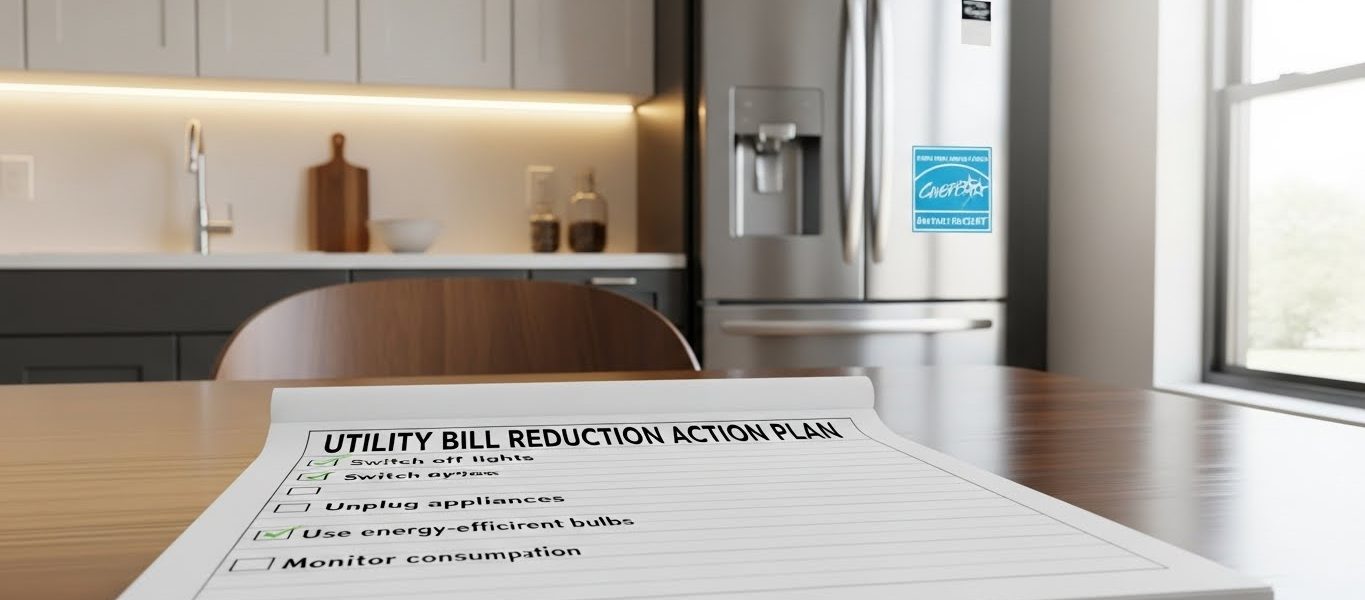
Consistency is key during this week. Research shows habits typically form after 18-254 days of repetition, with simpler habits forming faster. Use smartphone reminders or physical checklists until these energy-saving behaviors become automatic.
This week also involves educating household members about conservation goals and techniques. Everyone living in the home needs to understand both the financial benefits of conservation and the specific actions that contribute to success. Consider implementing a reward system that shares a portion of the savings with household members to maintain motivation. For more tips on how to save, explore ways to lower your bill.
Week 4: Program Applications and Long-Term Planning
The final week addresses longer-term strategies and administrative tasks. Complete applications for any assistance programs or rebates identified in week one. Develop a prioritized list of major efficiency upgrades based on your home’s specific needs, estimated costs, and potential savings. Create a budget allocation system that dedicates a portion of the utility savings to funding future efficiency investments, creating a virtuous cycle of continuous improvement.
Track Your Savings: How to Measure Success
Effective tracking reinforces your conservation efforts by documenting progress and identifying additional opportunities. Rather than focusing solely on dollar amounts, which fluctuate with utility rates and weather conditions, track your actual consumption in kilowatt-hours, therms, or gallons. Compare current usage to the same month in previous years, adjusting for significant weather differences using heating and cooling degree days (available from your utility or weather services).
FAQ’s About A Utility Bill Reduction Action Plan
Over years of helping households reduce utility costs, I’ve encountered certain questions repeatedly. These answers address the most common concerns and provide additional clarity on implementing an effective utility bill reduction action plan
.
How quickly will I see savings after implementing these changes?
Behavioral changes like adjusting thermostat settings and shifting usage to off-peak hours produce immediate savings visible on your next bill. Simple improvements like LED bulbs and water-saving fixtures typically show measurable impact within 1-2 billing cycles. Larger investments in insulation or appliance upgrades may take 3-6 months to demonstrate their full value, especially when implemented during moderate weather seasons. For comprehensive tracking, compare bills to the same month in the previous year rather than to the immediately preceding month to account for seasonal variations.
Which utility typically costs households the most money?
Heating and cooling typically represent the largest utility expense for most households, accounting for 40-50% of energy bills. In cold climates, heating dominates annual costs, while cooling represents the largest expense in warmer regions. Water heating usually ranks second at 14-18% of energy costs, followed by appliances (13%), lighting (9%), and electronics (9%).
This distribution explains why thermostat management and building envelope improvements (insulation, air sealing) deliver the greatest savings for most households. However, your specific usage pattern may differ – reviewing your detailed consumption data helps identify your largest opportunities.
Do I need professional help to make my home more energy efficient?
Many high-impact improvements require no specialized skills beyond basic DIY abilities. Installing weatherstripping, caulking air leaks, adding outlet gaskets, and installing programmable thermostats are well within the capabilities of most homeowners. Even adding insulation to accessible attics can be a DIY project with proper safety precautions.
Professional assistance becomes valuable for technical improvements like HVAC optimization, wall insulation installation, or advanced air sealing techniques. Many utilities offer subsidized professional energy audits ($50-150) that provide customized recommendations and connect you with qualified contractors. These assessments often identify improvement opportunities that wouldn’t be obvious through visual inspection alone.
Can renters still save money on utilities without making permanent changes?
Absolutely. While structural modifications may be limited, renters can implement numerous high-impact strategies. Behavioral adjustments like thermostat management and strategic appliance usage require no modifications. Temporary improvements such as window insulation film, door draft stoppers, and smart power strips can be installed without damage and removed when you move. Many utilities offer renter-specific efficiency kits with free LED bulbs, faucet aerators, and other portable efficiency tools.
How do I know if I qualify for utility assistance programs?
Eligibility criteria vary widely between programs and regions, but many have higher income thresholds than commonly assumed. As a general guideline, households earning up to 60% of their state’s median income often qualify for some form of assistance. For a family of four, this typically translates to annual income between $50,000-65,000, depending on location. Medical necessity programs, senior assistance, and military/veteran programs may have different or additional criteria beyond income.
The simplest approach is contacting your utility company directly through their customer assistance department. Representatives can screen your situation for all available programs simultaneously rather than requiring separate applications for each potential opportunity. Community action agencies and local energy assistance offices provide similar screening services with the added benefit of identifying non-utility assistance programs you might also qualify for.

By implementing the strategies outlined in this Utility Bill Reduction Action Plan, most households can reduce their utility expenses by 20-30% without sacrificing comfort or convenience. The key lies in a systematic approach that combines immediate behavioral changes with strategic improvements and program participation.
Life didn’t come with an instruction manual, but your financial freedom certainly should. Grab the full Ultimate Cash Savings Toolkit,which includes Utility Saving Hacks (also available seperately) to unlock the step-by-step blueprints for everything from slashing utility bills to crushing debt. Stop guessing what works and start following a proven roadmap.